Showing posts with label ConnexTo. Show all posts

Thursday, June 14, 2007

Freedom Trail DiMO (Digital Mobilities) Project featured on the next Mobile Monday Boston Event

DiMO Project example: Your visit to King's Chapel enriched by a more content available through mobile codesThe next Mobile Monday Boston event is going to be a great one! The theme is location based services and there are going to be fantastic speakers.

We are going to have a demo table to showcase the DiMO project, and then we will have a lightning speech on the project, by Ashley and myself.


The next meeting of Mobile Monday Boston will be on June 18th at 7PM. Our topic is Mobile Location. Jeff Glass will be our moderator.

We will have speakers on mobile location from 7pm to 8pm at MIT Sloan, room E51-335, 70 Memorial Drive, Cambridge, MA

Immediately following the speaking portion of the event, we’ll have complimentary food and drink at the Cambridge Brewing Company. Our sponsors are Autodesk, WHERE, and TeleAtlas.

If you are coming, please RSVP.


Get to the MoMoBoston site in one click with ConnexTo, the mobile code scanning solution


Looking fwd to see you!

Monday, June 4, 2007

ConnexTo loves Wiffiti!

During the previous Mobile Monday Boston, Stephen Randall from Locamoda presented their "writing on the wall" product suite: A series of fun interactive games, or interaction sessions where you stand in front of an electronic display and send SMSs to play games or interact.
"Our platform enables any phone to interact with screens connected to out-of-home networks, combining the power and reach of the web with the immediacy of the mobile phone"

One of their coolest applications is Wiffiti (Wireless Graffiti): these are virtual text boards that you can place on a real LCD in, say, a bar, on your site, blog, whatever. people can SMS to your Wiffiti to interact with you and/or others. This is really cool!!! I got an invitation to have one for myself today (Thanks Jayne!) and started using it. setup is easy and the first message was there in 5 minutes. See at the bottom right corner of my blog on this page, this is mine. You can send me a msg by sending @020406 (Space) your-message to 25622. OR, you can scan this code with ConnexTo and fill in your message:

Send a message to my wiffiti with ConnexTo, the mobile code scanning solutionHere's my Wiffiti itself: send me a msg and you'll see it here


Looking a bit closer, I think Stephen and his team made some good decisions with this product. For a start, Stephen was a founder of Symbian: he knows exactly the pain of creating a client application, getting that reach on enough phones/audience (Does phone xy support JSR-123 blah blah?), and then getting it on people's phones. So the waffiti thing doesn't require any client, no installation, no reach issues, none of that. Everyone has SMS, everyone know to use it. If I recall correctly Stephen still has non-gray hair on, and that's probably (in part) why.
Second, its a cool interesting, simple application. its engaging: the minute Stephen pulled it on the screen at the event, people started playing. He needed not say a word. This could go big.

The Economist is writing: "Between double espressos, patrons send text messages to the 50-inch screens...In March one woman received a marriage proposal via the Wiffiti screen at Toscanini's café (ooh...too geeky for me-AR)"


And if games, interaction, promotions aren't enough, why not reduce restaurant wait time?

VERY COOL!

Network World Partners With Nextcode's ConnexTo For Mobile Barcodes In Publications

This is big news for us: Network World (NWW) is an online and print publication, and they are starting to use ConnexTo codes to bring their subscribers closer to their brand and content.

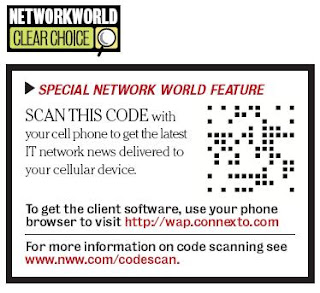
Network World Adding ConnexTo codes on their recurring publications for their mobile subscribers
As a first step, subscribers will be able to scan the code to get to their mobile site and get more information, read more etc. NWW obviously are thinking further down the line and are planning to make use of the unique advantage of mCodes: provide useful, positive experience to the subscriber immediately as they scan the code (namely, locally on the phone w/o having to go to the network to fetch whatever action is required): "(NWW:) We plan on creating a more immersive mobile online experience, such as being able to post a comment on an article through your phone or read other readers' comments."

Scott Shaffer has added a few of his comments on this (read here): "I think proprietary codes like mcodes, have a great chance of adoption because consumers will be able to recognize the distinct code and WILL KNOW what functions/applications are associated with them...ConnexTo's 2d barcodes look different, and perform a lot better, than most mobile barcodes."

Here's more coverage of the story from BtoB, The Magazine for marketing strategies, the story by Marie Griffin:
"Although it may look ordinary, the text box is somewhat revolutionary. It is likely the first time a business publication in the U.S. has offered its readers the option of getting to the information they seek on a Web site via the mobile Internet without keying in or clicking."

Friday, June 1, 2007

Avril Lavignes fans get real time mobile updates and content

Avril Lavigne Mobile Marketing CampaignAnother great step in bringing the crowds closer to community and services, (From 4Info blog:) Nettwerk has partnered with 4INFO to bring Avril Lavigne's fans real-time mobile updates and live messages from Avril. Fans can sign up for these messages on Avril's official website and Myspace page. Fans can also text the word “Avril” to 44636 (4INFO) to receive a menu of the latest Avril-related news, gear, promotions and concert and tour information.

This is really cool because its step taken in the North American stage, where things are maybe a little behind in some respects compared to other geographies. It seems like 4Info have got a lot going on, but this one has a lot of sizzle and will (hopefully) make its way into a large community.


I have to say I'm very happy for Nettwerk: First, I very much like their holistic approach when it comes to content distribution: they aren't cut-throat thirsty to get the dime out of your pocket. They will let you hear the music, experience it and then you can decide you like it enough to make a purchase. Second, this isn't the first step they've taken into the mobile space: they had tried going in with BNL ConnexTo campaign before. They're trying different approaches and will end up taking the ones that work.

Last, I love Avril's music. Like many other great stuff coming out of Ontario, she's really great, and has a good web presence and much more.

Good stuff.

Here's my little contribution: scan this code using ConnexTo to sign up for Avril's mobile updates, get content and much more:

Sign up for Avril Lavignes Mobile Marketing Campaign using ConnexTo, the mobile code scanning solution

Wednesday, May 30, 2007

Cell A House: the ConnexTo spin

Cell A House Mobile Marketing
Scott Shaffer has an interesting post on how Realtors and interested buyers can exchange information using their mobile phones. The service is brought by "Cell A House" from Mobile Visions. The benefits are obvious and immediate, as Scott states: "A great idea and long overdue". Imagine those ads on newspapers coming to life on your phone.

Let me add my 2 cents:
Right now the way to use the service is to text the (I'm guessing) house number to a short code. For example, you can try the service by texting H0000 to 95495. Sure, everyone has SMS and the service is easy and obvious...today. But-How many people get it right?


Let me propose a ConnexTo enhancement:
try scanning the code on the left using ConnexTo (get ConnexTo code reader to your phone from http://wap.connexto.com) (Sorry the code came out a little fuzzy but that's due to my graphical incompetency...)

Cell-A-House using ConnexTo, the mobile code scanning solution
Cell A House Mobile Marketing SMS Details

Interesting comment on proprietary vs. QR codes

Following a recent NYC "mobile camp" (good coverage from Mobilitee), Scott Shaffer commented the following in his excellent Blog:

"A couple issues I still see with PWC.

What or where this QR code give me? Outside of Semapedia ("Internet Dictionary") there is no mainstream application that encourages people to click on a code. Price comparison is the most discussed PWC application but that is for 1d codes (barcodes).

One of the reasons I like the proprietary code players Nextcode and BeeTagg is because their codes are distinguishable AND you know what information you will get when their codes are scanned.

There has to be a reason, or an expected outcome, to get people to scan a code. Curiosity won't drive adoption."

You can read the complete post here.

Saturday, May 19, 2007

ConnexTo international coverage

International coverage of ConnexTo, the mobile code scanning solutionYou'd be surprised what a quick search in Google digs up. I did a search for ConnexTo images and this is what came back.

Here's some complementary coverage of ConnexTo in Bulgarian (You can find a translation service here) (Thanks Vladimir) , and here's one from Italy in Master New Media picks. Very cool!

Friday, May 18, 2007

ConnexTo Review by Alessandro Pace and others

ConnexTo LogoIt's been a while since my last post...lots of work, interest and business. All's good!

It's always great to hear complementary reviews on your solution, especially if they come in midday Friday :-)

Italy Tourism ConnexTo codeHere's one that came from Alessandro Pace, an organizer of MobileMondayBoston group, a guru and Forum Nokia Pro in the flash space, and a great friend. Here's some of his thoughts: "I have to say that it worked like a champ. I was really impressed with their application and technology since my experience with other barcodes was not so great". You can read more here.


At the same breath, we received another quote from an impressed user (other side of the planet ...):
"I think that ConnexTo is better because of the following reasons:
It has a better error detection system, if the image is distorted or a little out of focus, it can still scan the code successfully. I did some testing with some codes on their web site and it was a lot better than others.
The client software is available for a variety of devices. It (the codes) can be created on many different shapes which makes it easier to fit on newspaper ads."


Anyway, enough for today, hope you enjoyed reading. If you have any comments yourselves, please let me know, I'll be looking forward to hear from you.
There's going to be a lot more news to share soon, watch this space!...

Thursday, April 26, 2007

DiMO (Freedom Trail) project site launched

You can view it here: www.dimoproject.net. Click on the tags link to view the content of the projects.

DiMO Boston Freedom Trail Project works using ConnexTo CodesWe had another very interesting review today. Some of the projects are extremely innovative and interesting. The view of adding dimensions into the freedom trail experience for tourists, to me, is the optimal application for code scanning technology: You're there and you can learn more. As Scott Shaffer wisely calls it "Physical World Connection".


ConnexTo Codes morphed in motion in the DiMO projectAnother interesting dimension of this project is the interaction with community, and with local authorities that manage the monuments along the trail. For example, Ashley had developed a very interesting and useful relations with the King's Chapel management, as did Michael in his 'Pub Crawl" project. Aaron links between the tourist experience and nearby community in the Bunker Hill area, Evan is building a community/WIKI set of pages to allow people to share their impression of the site. Matthew is sharing the true spirit of the North End, Paul will get you there with his "Charlie MBTA" project and Josh will allow you to "choose your own adventure".
Chris took an interesting task: make the trail friendly to those parents who are looking for adventure in the morning, but need to feed the kids, change diapers,...,...,,...Chris' Freedom trail is children friendly.
Theresa helps tourists navigate their way around Park St. Church. The cool idea I found in her project is the practical small card she created that people can theoretically pick up from the church or from their hotel.
Todd is linking mobile articles with community posts. Matt was looking at embedding codes and logos.
Jason's project is interest also because its a great starting point: he provides a video of the inside of King's chapel church if you get there 5 minutes after it closes. Pretty neat, I think, but what's even better is to show a bunch of alternating pieces of content: if you visit the chapel during the day, you can see how it looks at night, he can show ceremonies and other events.

Dominik's DiMO project created a Boston Common pamphlet with ConnexTo codes linking to digital contentAnd last, Dominik has a very cool pamphlet for Boston common with little two sided pieces that stick out: on one side you could identify the statue of the ducks, for example, on the other side you could scan the code to get to more content about it. This way a tourist can pick up a number of those as they begin their day in the hotel, and move about the city in a much more interesting way.

I invite everyone to review the projects and initiatives, and add your comments. To me, these projects are the starting point of something very interesting and valuable...I'm looking forward to see where it goes!


We are hoping to be able to show the project soon in one of the mobile Monday Boston events, with the presence of the students, hopefully Yasmine might be able to join. Stay tuned.

Even though we're hoping the project will continue, let me add a note of thanks: Many thanks to the talented students who created the content and worked hard; it really shows. Many thanks to Matt Gross from uLocate who helped (Have a good trip Matt! Arigato Gozaimase) and Devin from Sprint.
Last, a million thanks to Yasmine Abbas, whose talent and creativity inspired this project. It's time to use mCodes on your blog :-)
Good luck Yasmine in all your endeavors!

Wednesday, April 4, 2007

ConnexTo welcomes Mac/FF users

As of yesterday, ConnexTo code creation site supports also users who do not use Internet Explorer for web browsing, mainly Mac and FireFox users. You can just log in (or register if you've not done so yet) and start making your own codes (for non-commercial use). As every other technology company, we try focusing on the specific technology, but a recent encounter with 16 glowing apples in the dark made me move faster on this one :-)
Go for it, enjoy and let me know if you find anything broken.

Another little upgrade, we removed a couple of the redundant fields in the Join page to make it more friendly. hope peeps will find it more appealing to join and experience ConnexTo.
We also enabled you to send pictures of codes (if you don't have ConnexTo on your phone) to decode into Go@ConnexTo.com.

Another drop in the bucket :-)

Monday, April 2, 2007

Boston Freedom Trail Reloaded

For those of you who are planning to visit the Boston Freedom Trail in the next few months, you're in for a special treat: A group of young talented people will help you learn more about the points along the trail by watching a video, listening to audio or other pieces of content that will be available on the web, to your own mobile phone. You will be able to learn more and thus enjoy your visit much more.


They will also attempt to add useful information like what's the nearest restaurant/coffee shop/T station/...


The project is called "Freedom Trail Reloaded" or otherwise has also earned the name DiMO (website, Blog).


You ask yourself, how will I get to those videos/audio clips? the answer is, you will (hopefully) see codes on, around, or in the site. If you have a camera phone, you can download ConnexTo code reader here, and then all you need to do is point at the code to scan it, and it will take you to the video/audio. If you're not sure if your phone is supported, look here.
Here's a video that shows how to use ConnexTo.

It's important to add that as a guideline, the team will be very considerate of the surroundings when placing codes near touristic sites. This is part of the project: make the codes useful, but not intrusive. One wonderful example is an interesting relationship that evolved between the directors at the King's Chapel and Ashley, such that the codes will actually help the chapel in distributing information to the visitors.


Also, the guys who are creating this will be around, I think, during the weekends with their phones to help you try this out and also get your feedback.


So go for it and enjoy!


For those who have read so far, here's some background on this project: Leading the project is Yasmine Abbas, a lecturer at the Architecture department of the Wentworth Institute of Technology. Here's a quote from m-trends blog that I identify with, regarding Yasmine's work: "Sometimes one discovers blogs like rare pearls, usually not very known, a bit tucked away between the feeds of our information forest, yet often refreshing, thought-provoking, and stimulating our mobility senses. I stumbled a couple of times upon Yasmine’s blog while “re-searching” on augmented reality and mobility subjects." Yasmine herself is a rare pearl and its an honor to work with her.

Yasmine is leading a team of young, high energy, extremely bright students who are (for this project) looking at enriching a typical touristic experience with multimedia content, and connecting the tourists to it.


The students also have to think of their course theme, which gives the content and the way they think of it all an interesting twist.
Also involved in this initiative are Nextcode (providing the code scanning side of things) and uLocate. The team will be using Sprint phones to create the content and try the code scanning on site with tourists. These phones provide great video and audio user experience that every tourist will definitely appreciate.

Code scanning as means to enrich the tourism experience is not a new thing; one other initiative is using another code format and the project is called "Semapedia". The reason I'm writing this is because the more people gain benefit from using the codes to access content, and find it useful, it s in everyone's benefit.

The exciting difference in this project is that the students seem to have picked up on the codes to make them interesting and non-obtrusive to the friendly touristy experience. And so they are thinking what can be done with codes. There's a couple of very interesting examples. The team is extremely talented and I'm eager to see what new ideas they will bring on.


To me this is a very exciting initiative: its good for everyone in the game, including the tourist. All that's left to say is good luck to everyone!

Please check out the DiMO (website, Blog) occasionally for updates.

Saturday, March 17, 2007

The Quick'nDirty guide to ConnexTo

After having a session about mobile code scanning and ConnexTo at the Boston Barcamp2 (Thanks all attendees for coming! posting to follow) I was asked a couple of quick-beginner how-do-I questions that's worth covering real quick. This posting is not trying to discuss motivation for code scanning, but how to do it using ConnexTo.
  • creating codes: Log into ConnexTo site, where you can create code for URL, SMS, Phone Number and your contact information. (Note this is limited for non-commercial purposes). Feel free to save & use any of those codes, including sticking 'em on the back of your self-made business card :-) . MAC users: we are working to enable the site for non-IE users but its not there yet, its going to happen real soon so stay tuned.

  • Scanning codes- I am interested in downloading ConnexTo code reader application to my phone: Step 1- check that your phone is supported here. Step 2- launch your phone's web browser to wap.connexto.com. follow the download instructions to download the application. when you have the application installed, launch it (look for ConnexTo name and /or logo) and try it out. in most phones, all you need to do is aim the phone at a code and press the center button to scan. Its pretty simple, so don't be worried. check out this video on how to operate ConnexTo code reader (Thanks to Mark from Mark's Guide)


  • Scanning codes- I am NOT interested in downloading ConnexTo code reader application to my phone: step 1- take a picture of a code using your camera phone step 2- send the picture (via MMS or Email) to Go@ConnexTo.net. Our server will attempt to decode the code and respond to you (over SMS if you sent an MMS from the US, or over email if you sent an email in). Please keep in mind this service too is not supposed to be used for commercial purposes.
That's it! Try it, enjoy and tell me more about thoughts, comments and ideas it triggered.

Friday, March 9, 2007

Couple new toys in ConnexTo Code Reader

For those of you who are using ConnexTo and are interested, there's a couple updates:
1- We've enabled "contact information" code scanning for many of the Nokia and Sony-Ericsson phones that support J2ME programmatic access to the address book. Now in plain English: you can create codes that contain your contact information codes on ConnexTo site, stick 'em on the back of your business card, web page,... and now more of your friends can scan your contact information directly from that code.
Two notes worth making:
a- keep in mind, the more information in the code, the bigger the code, the harder it is to successfully scan 'em....contact information codes are typically big ones, so add only information you must have in there, and be patient...
b- On some phones, programmatic access to the address book is restricted. You can try your application options-permissions to see if there's something blocking ConnexTo from adding the contact to your address book.


2- A nice little add-on, now when you scan a "URL code", you can also share it with your friend(s) by selecting "forward"

So, for Nokia or Sony-Ericsson phone owners, there's a new version waiting for you on ConnexTo download site.
Enjoy!

Wednesday, March 7, 2007

ConnexTo at the Boston BarCamp

On March 17-18, Boston will have its 2nd BarCamp. Boston Bar Camp is "an unConference, organized on the fly by attendees, for attendees".
Unfortunately I will only be there on the 17th, and I'll attempt to get people interested in hearing a session on mobile code scanning and ConnexTo. As much as I'm enthusiastic about what ConnexTo might be able to do today, I'm more interested in other people's ideas.
Here I created a mock up personalized sticker that I'm toying with.
So if you're in the area and interested, hop in around afternoon time on March 17th, Ray and Maria Stata Center (Bldg. 32)
MIT
32 Vassar Street
Cambridge, MA 02139

And hopefully you'll get to hear a bit about mobile code scanning.
See you there!

ConnexTo on YouTube and Mark's Guide

This is so cool: Mark (the author of Mark's Guide ) had a chance to play around with ConnexTo and it certainly seems to have gotten his attention. He's not a lazy guy, this chap, and so he took his camera and created the simplest, greatest video of ConnexTo in action. Plus his own notes on the technology, titled: Nextcode's ConnexTo mobile code scanning makes entering data a snap. This post made it to the pondering primate blog!. Mark- that's awesome!
You can view the posting and see the YouTube video right here.

This is all very exciting...what's most exciting to me is that there's ever-increasing attention to code scanning and where it (w/c/sh)ould go. Every time I meet with someone I hear this new idea. Mind you, some aren't as great, but others are very cool.
Enjoy!!

Two new campaigns from Smart


I'm a little swamped these days, hence short and quick post:
Smart are keeping up the beat of interesting code-scanning based campaigns coming in, based on their product DECODE. As I keep saying, Smart are moderating the introduction of the new services such that they don't overwhelm their subscribers.

First, last Saturday Smart enabled consumers to vote for "BinibiningPilipinas" Miss Philippines through code scanning (see below). The candidate that got the most text votes got the “SMART Texter’s Choice” award. Congratulations to the beautiful winners!


Next, Smart are holding their annual "Smart Sweep" event, an event dedicated, if I understand correctly, to the local developer community. Smart are presenting their DECODE code scanning product to developers, I'm guessing they are opening the stage (good for them!) for new ideas and innovation. Here's the specific page for the DECODE product.

Thursday, March 1, 2007

Another piece from Smart's DECODE

I just came across another advertisement for Smart Decode:

Besides loving the graphics on this, the whole message is simple, clean, and inviting.
"No need to type in keywords or access codes...Scan the code and your phone does the rest"...I love it. There's more to come, watch this space...

Monday, February 12, 2007

SMART MOBILE DECODE

I am so excited: Smart Communications, leading wireless telco in the Philippines (22.9M Subscribers), had launched their mobile code scanning service, named DECODE, last Saturday, Feb 10th, 2007.


What's exciting about it, is that the team at Smart did their homework on the factors that will drive consumer adoption:


  • Short learning curve: The Smart DECODE application, although robust, is unbelievably straight forward to understand and use. Moreover, Smart made sure there are guiding ads in newspapers and media


  • DECODE Distribution: Smart made DECODE easily accessible for free on WAP as well as a shortcode to download the application. But- they've taken it one step further: the code reader contains an option to invite your friends to use the application.


  • Attractive offering drives user adoption: During the campaign Smart are "giving away free content during the launch, including free polytones, mms wallpapers and logos"


  • During the launch, KISS (Keep It Simple, Stupid): Smart team were smart to not overload the consumers on launch with all their options. They get the code readers out there, and gradually introduce new codes with compelling use cases. Very clever.


  • REACH: Everyone has this problem, but Smart, a wireless telco, took control and managed to get DECODE on over 70 (!) of the more popular phone models. It means that in most cases, consumers can share the excitement with their friends, almost no one is left out.


  • Select the right occasion for the launch: Well, this one is a question of taste, Smart chose "LovaPalooza" to launch DECODE: "This past weekend, 6,124 kissing couples in Manila broke the world record for “Most Couples Kissing in One Event”! "


          • Control over the codes: Yup, Smart chose a proprietary code format, mCodes. They had their own reasons, but let me propose just one possible scenario (apologies in advance to QR/DM lovers out there): What if this was based on an open code, say QR. What if some punk, on the launch event, would print some malicious code (I mean, everyone can do ANYTHING with QR, right?) and spread it around Asia mall. What would be the color on the organizers faces?? If you're a telco, better watch out for that trick mate. Smart want and will allow their subscribers to create codes, "Decentralizing the power" to their subscribers. By using this code format, Smart moderate the use format of codes such that all consumers can enjoy predictable user experience, key to a service success.

          • Distribution to intended user base (quote from this blog): "Take note that you need to use your Smart cellphone to download Decode. You cannot download the application using a Globe or Sun SIM, or even your good ol' DSL connection.". OK, you think, what's the big deal, right? teclos can control who downloads what and when. But there's much more here: Smart intended for this application to be for a defined user group: their subscribers. More to come, watch this space...

          And finally, another quote from the chette Blog: "Decode proves that Smart still embraces cutting edge technology. ...If Smart plays its cards right, this technology will be a breakthrough in future mobile services."

          The team at Smart, IMHO, are smart people. Nothing they did here was an afterthought. The way they've handled it so far, they'll take it far, just like other unique, successful services they have. I applaud you!

          I wrote in an earlier post: The jury is still sitting in court (talking about eagerness to see code scanning campaigns consumer feedback). Well, in this case, the jury is slowly leaving the room. I can't wait to hear what they have to say!

          Friday, February 9, 2007

          Standards in emerging spaces

          One of the blessings of recent times in technology is introducing open standards: It turns industries around, it turns products around. It introduces new opportunities and new players that find themselves in a position to enter spaces they've never played before. And its all for the best.
          Naturally in this context, the mobile code scanning space is one that is close to my heart. Clearly an emerging space, disruptive technology that aims to change the realm of how users (and by that I think its targetting consumers mainly) use and percieve their phones. There's a big promise and potential success in this space.
          Looking at this space from a standards perspective, here's a couple of things that can be said:
          • It's an emerging market
          • Barcodes in themselves is not new. Its the innovation that brings code scanning to new phones that have cameras. Its the exploding new services on the phone and on the web that create a compelling story (see this great piece on mobile 2.0 by Rudy at m-trends)
          • Today there are two open standard codes: DataMatrix and Quick Response (QR). Both of which had certain success stories
          • Vendors that are playing in this space are devided in two: those who base their technology on those standard codes and those who either offer proprietary codes or go hybrid (supporting both)

          A lot hads been said about applying standards to this space: in favor and against, for this code format or another: Tommy's S60 Applications blog (Re Standards:"Unless we do something, fragmentation is threatening the whole 2D barcode ecosystem." or, "First: totally agree - go for the standards - QR Codes and Datamatrix (we support them already:). If this is set, half of the battle is won."), Excellent coverage from 'The Pondering Primate' Blog including a coverage on the consortium initiative.

          Why am I writing this? because I'm a little ticked every time I read about someone "declaring the standard" as one format or another. Here's my non-expert take on this.

          Shift thoughts: a while back I was playing in the Push-To-Talk-Over-Cellular space (Lets call it PoC for the mental health of my fingers) . This is just about the time when IMS and IMS-based services were getting some traction and mountains of hype. Several things happened around PoC:

          • It was emerging disruptive technology
          • It was based on revolutionary IMS grounds and thus one of the first of many IMS services
          • It's success, for good or bad, was somewhat an indicator for the whole IMS investments
          • The big infra/phone vendors got together to set a standard to ensure interoperability pretty early in the game
          • Pleanty of smaller players in the space
          • There was a reference technology launch (in the US)

          Similar situation, right? Let me quote from The pondering Primate Blog (becuse I was having the same thoughts at the time): "I agree 100% with this idea, but I question the motives, the companies, and the timing of this effort." (this is in regards to the code scanning consortium).

          Here's how things rolled out from there: 5 big players started standardization. After making some headway, one left and started doing his own thing. Now we're with two different standards. As solutions started materlializing, we now have systems based on two different standard, and not necessarily interoperating. Remember, this is both an infrastructure and client application architecture. Imagine the scenario for an operator: users of one vendor's handset can't PoC to users of different vendor's handsets, both subscribers of the same carrier. Then came Open Mobile Alliance (OMA) and created PoC OMA V1.0.

          Is PoC succesful today? You be the judge.

          What's my point? My point is that standards don't create good solutions. good solutions create good standards. How do you know when you have a good solution? When the target user tells you so. When the players in the eco system are forcasting good returns. When there's good adoption and feedback during the trial. when your trial gets good interest from players OUTSIDE of the ecosystem. what happens when you force standards on a premature space? you get bad systems and bad standards, the ones that won't get adoption.

          Back to mobile code scanning: An emerging space, lots of innovation, two open standards that have some success under certain conditions, lots of players. Has there been ANY serious launch (outside of Japan, people in the space know why I'm adding this comment) with measurable criteria that established one code more commercially successful than others?

          Don't get me wrong, I'm all for open standards and that consortium initiative (this could even become one of those once a month meetup some other place in the world kinda thing!) WHEN THE TIME IS RIGHT. As an example: Is it reasonable to expect now that all the players in the space to agree on a starting point whose technology works best?

          I say, when it comes to establishing what's a good mobile code scanning system, what defines it, and make that the standard, the jury's still's sitting in the court room

          And for entrepreneurs thinking about mobile code scanning, or are in a similar call for standards on emerging space I say: your job is to excel and innovate, not to reinvent the existing. You'll be competing in a commodity market where others had spent more resources than you'll have during your first step. Get a great product, and set the standards by marching the end user to your shop. Help the consortium by adding your innovation that's been validated.