Thursday, May 31, 2007

Check out Massachusets Gas Prices cool mobile access

Mobile code scanning enables users to access gas prices on the go
For those of you who are price sensitive when you're refueling your car (and are getting ready for when we hit the $4/Gallon point), I found this cool website called "Massachusetts Gas Prices", which has lots of useful information besides just giving you the cheaper options in your area. For example, you could find historical gas price chart in the last, say, 2 years, compared to crude oil prices here.

They also offer a nice little WAP site accessible from your phone called GasBuddyToGo.com. You get there, enter your zip code (or where you want to refuel) and get the cheaper stations in that area. Here's the page that describes how it works, you also have an SMS options etc.

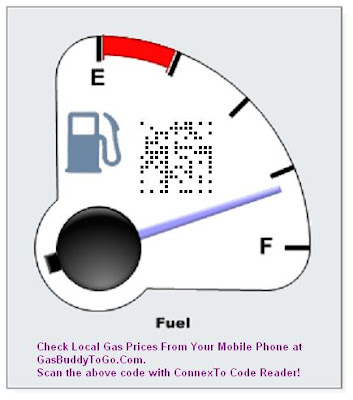
Here's a code that links there so you can print yourselves and keep in the car :-)Check local gas prices using ConnexTo, the mobile code scanning solution

Wednesday, May 30, 2007

Cell A House: the ConnexTo spin

Cell A House Mobile Marketing
Scott Shaffer has an interesting post on how Realtors and interested buyers can exchange information using their mobile phones. The service is brought by "Cell A House" from Mobile Visions. The benefits are obvious and immediate, as Scott states: "A great idea and long overdue". Imagine those ads on newspapers coming to life on your phone.

Let me add my 2 cents:
Right now the way to use the service is to text the (I'm guessing) house number to a short code. For example, you can try the service by texting H0000 to 95495. Sure, everyone has SMS and the service is easy and obvious...today. But-How many people get it right?


Let me propose a ConnexTo enhancement:
try scanning the code on the left using ConnexTo (get ConnexTo code reader to your phone from http://wap.connexto.com) (Sorry the code came out a little fuzzy but that's due to my graphical incompetency...)

Cell-A-House using ConnexTo, the mobile code scanning solution
Cell A House Mobile Marketing SMS Details

Interesting comment on proprietary vs. QR codes

Following a recent NYC "mobile camp" (good coverage from Mobilitee), Scott Shaffer commented the following in his excellent Blog:

"A couple issues I still see with PWC.

What or where this QR code give me? Outside of Semapedia ("Internet Dictionary") there is no mainstream application that encourages people to click on a code. Price comparison is the most discussed PWC application but that is for 1d codes (barcodes).

One of the reasons I like the proprietary code players Nextcode and BeeTagg is because their codes are distinguishable AND you know what information you will get when their codes are scanned.

There has to be a reason, or an expected outcome, to get people to scan a code. Curiosity won't drive adoption."

You can read the complete post here.

Saturday, May 19, 2007

Smart's DECODE mobile codes

Smart DECODE mobile codes based on ConnexTo technologyI had mentioned this earlier in my posts, but now I can show it:
Here's one cool picture from a Smart store. These codes allow people to get content from Smart's deck by simply clicking to scan a code. simple, right?


If you're not a Smart Communications subscriber, you're bound for a little surprise: The standard ConnexTo code reader will scan the code, but it won't tell you what's the content of this code!


Smart DECODE mobile codes based on ConnexTo technologyThese codes are "Smart codes", meaning that only Smart Communications can create those codes and only Smart subscribers can use them. Why? because those codes connect to Smart's mobile payment/purchasing solution, and clearly Smart wanted only their subscribers to enjoy the benefits of their solution. Get it?

ConnexTo allows you to have "public codes" that everyone can create, anyone can scan using the "public" code reader. BUT in addition, using ConnexTo, a carrier, advertiser, operator or anyone else, can create a targeted campaign, which will allow special features only to their intended audience. Only they can create those codes, and only their audience, using the "customized" code reader can scan them. Here's a couple more advantages of this approach:
  • The campaign owner (brand, operator,...) has full control to customize their user experience. for example, if they want to show a product name, price and get user input, they can do so. by doing that they ensure predictable positive user experience.
  • Second, the campaign owner can prevent frauds by inserting hidden information into the code, that provides authenticity to the message. the user can see the visible fields and enter their input, but they don't get to see the security stuff behind the scenes.
  • Third, obviously this gives campaign owner the ability to give special offers to their subscriber base, keeping them happy and bringing new ones in.
I think its quite powerful.

ConnexTo international coverage

International coverage of ConnexTo, the mobile code scanning solutionYou'd be surprised what a quick search in Google digs up. I did a search for ConnexTo images and this is what came back.

Here's some complementary coverage of ConnexTo in Bulgarian (You can find a translation service here) (Thanks Vladimir) , and here's one from Italy in Master New Media picks. Very cool!

Hear It 'N Get It: New service that brings consumers closer to mobile content

Hingi: Hear it N Get it mobile Content CampaignJust came across a very cool service for mobile users: "Hear it 'N Get It". Supposedly, once you hear a song you like on TV or on the radio, the service will allow you to send an SMS to a shortcode (4144) with the name of the TV/Radio channel. You will get an SMS back with links to the last 3 songs played and then you can download various versions of the content.
Here's their version: "Hear It 'N Get It allows users to buy mobile content in just 2 clicks, irrespective of the type of the handset they use, or the broadcast source of the music they hear.The service requires no agent software, no portal and no search-engine."

So that's the service, here's a couple thoughts:
  • What caught my eye is the healthy approach the company (Hingi.com) is taking: "Users buy content in just 2 clicks". Service sign up? NO, Support for pre-paid subscribers? YES, Limitations on who can use it? NO, What am I being charged for? you'll get charged only if the song was found, any fixed charges? NO. Reach, Simplicity and Value are the name of the game.
  • I LOVE the design on their consumer-oriented site (Hebrew, English). It's cool and immediate to understand: what is the service about, how does it work for me.
  • The challenge, as always is the consumer education: How do I know about the service, the shortcode and the exact code for the station. But: with the right business model, they can get the station to promote their service.
Unfortunately it seems like the service for now is available only in Israel, but with a recent $3.4M investment, I'm sure they are thinking global :-)
Good luck guys!

Friday, May 18, 2007

ConnexTo Review by Alessandro Pace and others

ConnexTo LogoIt's been a while since my last post...lots of work, interest and business. All's good!

It's always great to hear complementary reviews on your solution, especially if they come in midday Friday :-)

Italy Tourism ConnexTo codeHere's one that came from Alessandro Pace, an organizer of MobileMondayBoston group, a guru and Forum Nokia Pro in the flash space, and a great friend. Here's some of his thoughts: "I have to say that it worked like a champ. I was really impressed with their application and technology since my experience with other barcodes was not so great". You can read more here.


At the same breath, we received another quote from an impressed user (other side of the planet ...):
"I think that ConnexTo is better because of the following reasons:
It has a better error detection system, if the image is distorted or a little out of focus, it can still scan the code successfully. I did some testing with some codes on their web site and it was a lot better than others.
The client software is available for a variety of devices. It (the codes) can be created on many different shapes which makes it easier to fit on newspaper ads."


Anyway, enough for today, hope you enjoyed reading. If you have any comments yourselves, please let me know, I'll be looking forward to hear from you.
There's going to be a lot more news to share soon, watch this space!...

Thursday, April 26, 2007

DiMO (Freedom Trail) project site launched

You can view it here: www.dimoproject.net. Click on the tags link to view the content of the projects.

DiMO Boston Freedom Trail Project works using ConnexTo CodesWe had another very interesting review today. Some of the projects are extremely innovative and interesting. The view of adding dimensions into the freedom trail experience for tourists, to me, is the optimal application for code scanning technology: You're there and you can learn more. As Scott Shaffer wisely calls it "Physical World Connection".


ConnexTo Codes morphed in motion in the DiMO projectAnother interesting dimension of this project is the interaction with community, and with local authorities that manage the monuments along the trail. For example, Ashley had developed a very interesting and useful relations with the King's Chapel management, as did Michael in his 'Pub Crawl" project. Aaron links between the tourist experience and nearby community in the Bunker Hill area, Evan is building a community/WIKI set of pages to allow people to share their impression of the site. Matthew is sharing the true spirit of the North End, Paul will get you there with his "Charlie MBTA" project and Josh will allow you to "choose your own adventure".
Chris took an interesting task: make the trail friendly to those parents who are looking for adventure in the morning, but need to feed the kids, change diapers,...,...,,...Chris' Freedom trail is children friendly.
Theresa helps tourists navigate their way around Park St. Church. The cool idea I found in her project is the practical small card she created that people can theoretically pick up from the church or from their hotel.
Todd is linking mobile articles with community posts. Matt was looking at embedding codes and logos.
Jason's project is interest also because its a great starting point: he provides a video of the inside of King's chapel church if you get there 5 minutes after it closes. Pretty neat, I think, but what's even better is to show a bunch of alternating pieces of content: if you visit the chapel during the day, you can see how it looks at night, he can show ceremonies and other events.

Dominik's DiMO project created a Boston Common pamphlet with ConnexTo codes linking to digital contentAnd last, Dominik has a very cool pamphlet for Boston common with little two sided pieces that stick out: on one side you could identify the statue of the ducks, for example, on the other side you could scan the code to get to more content about it. This way a tourist can pick up a number of those as they begin their day in the hotel, and move about the city in a much more interesting way.

I invite everyone to review the projects and initiatives, and add your comments. To me, these projects are the starting point of something very interesting and valuable...I'm looking forward to see where it goes!


We are hoping to be able to show the project soon in one of the mobile Monday Boston events, with the presence of the students, hopefully Yasmine might be able to join. Stay tuned.

Even though we're hoping the project will continue, let me add a note of thanks: Many thanks to the talented students who created the content and worked hard; it really shows. Many thanks to Matt Gross from uLocate who helped (Have a good trip Matt! Arigato Gozaimase) and Devin from Sprint.
Last, a million thanks to Yasmine Abbas, whose talent and creativity inspired this project. It's time to use mCodes on your blog :-)
Good luck Yasmine in all your endeavors!

Tuesday, April 24, 2007

Smart Network, Dumb Codes

Dumb codes + Smart network? Smart codes that allow robust immediate actions and user feedback on the phone? ConnexTo allows you the flexibility to chooseIn a recent discussion an interesting comment was made on the vision of mobile codes in the Content/Services-Operators-Consumers triangle:
"My network is SMART: I can find who are my subscribers (in the case of a brand, who are my customers), and I can make very intelligent decisions in the network. Moreover, the network has more resources and is more flexible to allow changes and new functionality into the ecosystem, which would improve dramatically the value to consumers. Why invest so much in smart codes that do a lot on the phone and rely less on the network?".
Excellent point, I'll say. Network means flexibility and robustness, more value, updates etc. Perhaps even remove the need for a client on the phone (getting consumers to download an application to the phone is about as easy as pulling teeth) or maybe a thin client; if the network takes the action associated with the code then the dependency on the phone's support for various APIs, like multimedia for example, or PIM, is largely removed.
I'll make two points to offer another perspective on this:
  • Physical World Context: OK, so you want to do everything on the network, fine. But think of the consumer: they are in the context of some experience, related to location, time, identity and other parameters that change the way they perceive the value that would be offered to them by scanning the code. If I'm scanning the menu of a restaurant, I might be interested in their dinner or lunch menu, depending on the local time on my phone. Connecting to the network, Smart codes can take samples of local data that indicates the context of the user's world.
  • Offering local, immediate value: I'll take a wild guess here, but I would say that most consumers want immediate value for their interest. By limiting the ecosystem such that valuable feedback or recognition is only given at the network level, the process of getting there becomes longer, it adds user prompts and question marks. With every click, the number of consumers drops. The benefit of smart codes is that even if the value (ringtone, coupon,...) is on the network, you can offer the consumer immediate compelling evidence to give them some assurance that they're on the right track. their willingness to step the extra mile will be different.
  • Evolving ecosystem: As a last comment, I personally think we are all (in this space) "dumb" prophets trying to see how this story will pan out. Will codes get consumers to the mobile web/content/services? Will phones have more services on-board (FM Radio, PIM,...?) or will it all move to the network. One thing is for sure: it will all take time to find out. In the mean time, if you are betting your cards on "dumb codes" that connect to the web to take the associated action, you are limiting yourself from taking local actions today (add a meeting to your calendar), from users who today do not have data plans, and future flexibility options. Is this a bet worth taking?

Friday, April 13, 2007

Mobile Code Scanning in China [BusinessWeek]


Excellent piece today in BusinessWeek on code scanning campaigns in China: "The lucrative potential of the mainland's tech-starved mobile advertising market could be unlocked by two-dimensional barcodes". Speaks to the potential value of code scanning, and the issues innovators see in this emerging space. Here's some of my favorite quotes:

Value for the user:
"(barcodes turn)...your mobile phone into a giant mouse pointer"
Value to the operator/ad agency/brand:
"it can help advertisers build detailed databases and customer profiles. Location, content viewed, mobile phone used - it can all be traced"

Evolving China market:
"China's mobile advertising market is starved of such innovative delivery methods. The market is currently dominated by SMS advertising, which relies on the cheapness of untargetted text messages. SMS advertising is a "push" technology, leaving consumers at the mercy of advertisers. But with barcodes, the consumer chooses whether or not to click"


On the maturity of the evolving space:
"It's a chicken and egg situation, you have to get enough content to attract consumers, and enough consumers to attract advertisers. Right now we just want to get the motion going"


On who will decide on preferred code format selection:
"Which barcode standard ultimately wins China Mobile's favor and dominates the advertising space is still up in the air. The consumer, however, won't want an advertising system that doesn't work.

"The end-user doesn't care what technology they use. As long as one service is more convenient, [he] will choose it"


I think that mobile code scanning should be absolutely free for consumers. there's enough cake for the advertisers to feed on to sponsor these things. critical for uptake. Also critical, is preloading the client on the phone; a critical challenge for mass consumer adoption.

The comment on the availability of IP access and network resources is a good one. The code scanning experience should be rewarding to the consumer, and thus the code itself should contain sufficient information without requiring the consumer to log onto a WAP server just to know what this code does. This approach relies on the availability of a data plan and that the user is willing to pay the charges. This approach also removes the options to take local actions such as playing a file or adding an event to your calendar.